

Views: 0 Author: Maya Medical Biomedical Team Publish Time: 2026-10-27 Origin: Site


Surgical theatres and intensive care units (ICUs) represent the highest-acuity environments within any hospital facility. Together, they manage critical patient resuscitations, complex general and trauma surgeries, and post-operative life support. For healthcare administrators, chief surgeons, and biomedical procurement officers in emerging healthcare markets, outfitting an operating room (OR) and ICU requires rigorous planning. Equipment choices must ensure absolute clinical reliability, gas and electrical interoperability, sterile field ergonomics, and resilience against utility fluctuations. This engineering guide details the core components, clinical layout criteria, and procurement specifications required to build a modern, turnkey surgical and critical care facility.
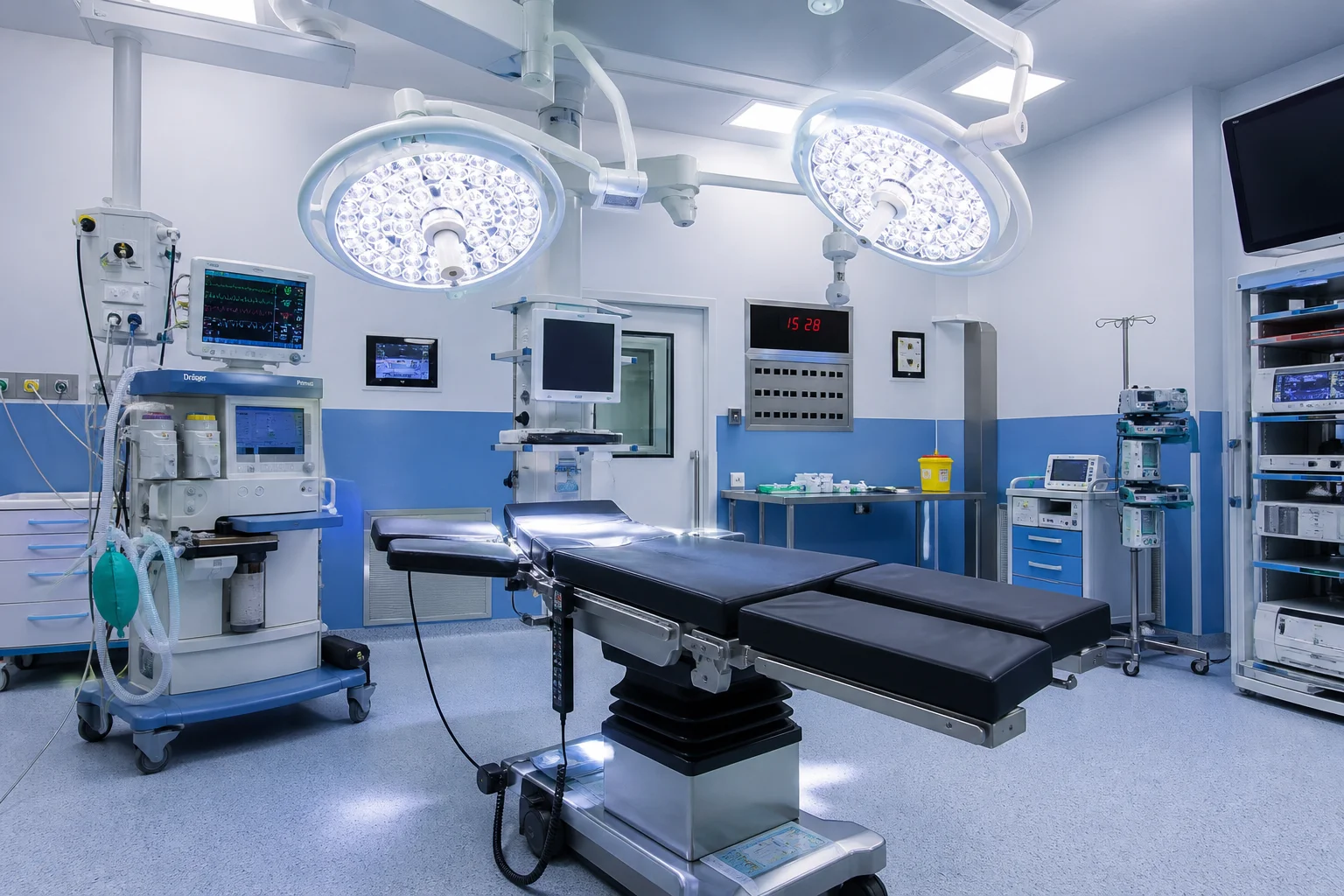
A modern operating theatre relies on synchronized mechanical and electronic systems designed to maintain sterile airflow, provide shadowless surgical cavity illumination, and achieve precise patient positioning across surgical specialties.
The surgical operating table is the mechanical anchor of the operating room. Procurement teams should prioritize multi-position electric hydraulic operating tables equipped with:
Versatile Postural Articulation: Motorized adjustments for Trendelenburg / Reverse Trendelenburg (≥25°), lateral tilt (≥20°), back plate elevation (≥75°), flex / reflex angles, and built-in mechanical kidney elevators.
Radiolucent Tabletop & C-Arm Clearance: Carbon-fiber or high-transmittance radiolucent phenolic tabletop sections with continuous longitudinal slide (≥300mm), allowing full-body intraoperative C-Arm imaging without repositioning the patient.
Dual Control & Battery Backup: Integrated side-panel manual override controls alongside an ergonomic handheld wired remote, supported by an internal rechargeable battery offering 50 to 80 continuous operational cycles during grid power outages.
Adequate illumination directly influences surgical precision and operator fatigue. Modern OR standards demand dual-dome ceiling-mounted LED surgical lights featuring:
Illumination Intensity & Color Temperature: Central illuminance ranging from 120,000 to 160,000 Lux, with variable color temperature adjustment (3,800K to 5,000K) to enhance tissue contrast between vascular, muscular, and neural structures.
High Color Rendering Index (CRI): Ra ≥ 96 and R9 (saturated red) ≥ 92, ensuring natural visual tissue rendering.
Deep Cavity Shadowless Technology: Multi-lens optical arrays that maintain focused light columns even when surgeons' heads obstruct the beam path, emitting minimal thermal radiation (temperature rise at surgical field < 1°C).
For tissue dissection and immediate hemostasis, high-power electrosurgical generators (300W to 400W) with monopolar cutting/coagulation and bipolar micro-coagulation modes are indispensable. Critical safety specifications include real-time contact quality monitoring (CQM) systems that instantly deactivate output if patient return electrode pads detach, preventing accidental patient burns.
Anesthesia delivery systems have evolved from simple pneumatic flowmeters into comprehensive clinical workstations that integrate closed-loop electronic ventilation, automated vaporizers, and integrated agent monitoring.
Pneumatic vs. Electronic Drive Ventilators: Electronic-driven, micro-processor-controlled ventilators eliminate driving gas consumption, an essential operational benefit in regions where medical oxygen cylinder supply is constrained.
Comprehensive Ventilation Modes: Standard modes must include Volume-Controlled Ventilation (VCV), Pressure-Controlled Ventilation (PCV), Synchronized Intermittent Mandatory Ventilation (SIMV-V/SIMV-P), and Pressure Support Ventilation (PSV) with apnea backup for spontaneously breathing patients.
Precision Temperature-Compensated Vaporizers: Multi-agent Selectatec-compatible vaporizers (Sevoflurane, Isoflurane) with automatic flow and temperature compensation, ensuring constant anesthetic concentration delivery.
Active Waste Anesthetic Gas Scavenging (AGSS): Built-in active or passive scavenging ports to capture exhaled anesthetic vapors, protecting theatre surgeons and nursing staff from chronic occupational gas exposure.
The Intensive Care Unit demands continuous, high-reliability patient monitoring and invasive mechanical life support engineered for 24/7/365 operational uptime.
High-acuity ICU patient monitors must provide modular flexibility:
Essential Parameter Suite: Standard monitoring of 3/5-lead ECG, SpO2 (anti-motion and low-perfusion algorithms), Non-Invasive Blood Pressure (NIBP), Respiration Rate, and dual-channel Temperature.
Advanced Critical Care Upgrades: Plug-and-play modular connectivity for Invasive Blood Pressure (IBP dual-channel for arterial and central venous monitoring), End-Tidal CO2 (EtCO2 microstream or sidestream capnography), and Cardiac Output (CO).
Central Monitoring Station Integration: Wired or wireless Ethernet connectivity enabling up to 32 or 64 bedside monitors to link back to a central nursing monitoring console with audible and visual arrhythmia alarm cascading.
For acute respiratory distress syndrome (ARDS), post-surgical weaning, and pulmonary trauma, dedicated ICU ventilators require:
High-flow oxygen therapy (HFNC) capability alongside invasive and non-invasive ventilation (NIV).
Comprehensive respiratory mechanics measurement (auto-PEEP, lung compliance, airway resistance, work of breathing).
Built-in air compressor options for healthcare facilities lacking centralized piped medical air pipelines.
The matrix below summarizes the equipment requirements for establishing a functional 2-theatre surgical suite and 6-bed ICU facility:
Clinical Area | Core Equipment Package | Recommended Technical Standard | Facility Requirement |
|---|---|---|---|
Operating Suite 1 (General/Trauma) | Electric Hydraulic Operating Table, Dual LED Lights (160k/120k Lux), 350W ESU, Anesthesia Machine | C-Arm radiolucent slide, CQM burn protection, electronic gas mixer | Central O2/N2O/Air drops or dedicated gas cylinders, 220V UPS |
Operating Suite 2 (Maternal/OB-GYN) | Multi-function OB/GYN Electric Delivery/Surgical Table, LED Surgical Light, ESU, Baby Warmer | Trendelenburg tilt, perineal cutout, integrated infant resuscitation | Scavenging exhaust port, laminar sterile ceiling airflow |
Intensive Care Unit (6 Beds) | 6× 12-Inch Multi-Parameter Monitors, 3× ICU Ventilators, 12× Syringe/Infusion Pumps | EtCO2 capnography, dual IBP, invasive/NIV modes, dose-rate calculation | Central nurse station wiring, dedicated backup diesel generator |
Recovery / Post-Anesthesia (PACU) | 4× Spot-Check Patient Monitors, Defibrillator with Pacer, Mobile Emergency Suction Units | Biphasic defibrillator with internal paddles, high-capacity vacuum | Oxygen flowmeters, emergency crash cart stations |
Procuring surgical theatre and intensive care equipment from fragmented third-party suppliers introduces severe clinical compatibility and integration hazards. Maya Medical resolves these systemic obstacles through pre-engineered, factory-tested turnkey departmental packages:
Factory Gas & Electrical Standards Matching: Prior to container packing, all anesthesia gas inlet terminals and surgical ceiling pendant drops are pre-fitted with quick-connect probes matching local hospital architectural standards (British BS, German DIN, French AFNOR, or American DISS), paired with dedicated voltage stabilizers.
Consolidated Multi-Device Testing: The electric hydraulic operating table, dual-dome LED surgical light, electrosurgical generator, anesthesia workstation, and vital signs monitors are assembled and operated as an integrated clinical department suite at our testing facility to verify electromagnetic compatibility (EMC) and mechanical harmony.
Streamlined Turnkey Export & Customs Handling: Consolidated shock-resistant wooden crating, marine insurance coverage, pre-shipment compliance audits (TUV/SGS), and destination regulatory documentation (SONCAP, COC, PVoC) are coordinated under a single unified commercial invoice and bill of lading.
Round-the-Clock Engineering & Training Support: Real-time 24/7 technical advisory desk via WhatsApp (+86-189-2504-4116), backed by senior biomedical specialists providing direct video commissioning, ventilator parameter configuration guidance, and preventive maintenance scheduling.
Maya Medical provides configurable gas inlet connections accommodating standard international fittings, including British Standard (BS), German DIN, French AFNOR, and American DISS diameter-index safety systems, ensuring direct compatibility with hospital wall gas terminals.
Maya Medical ICU ventilators feature internal hot-swappable dual lithium batteries delivering 3 to 4 hours of continuous mechanical ventilation during total grid power failures. Patient monitors include internal lithium-ion batteries providing 4 to 6 hours of continuous vital parameter monitoring.
Our biomedical engineering project team collaborates with hospital architects to review laminar airflow diffuser placements, medical gas pendant locations, and operating table positioning, ensuring clean air delivery directly over the sterile surgical field.


